
Five Biggest Winners and Losers from Thursday’s March Madness Action
By 234sport Staff
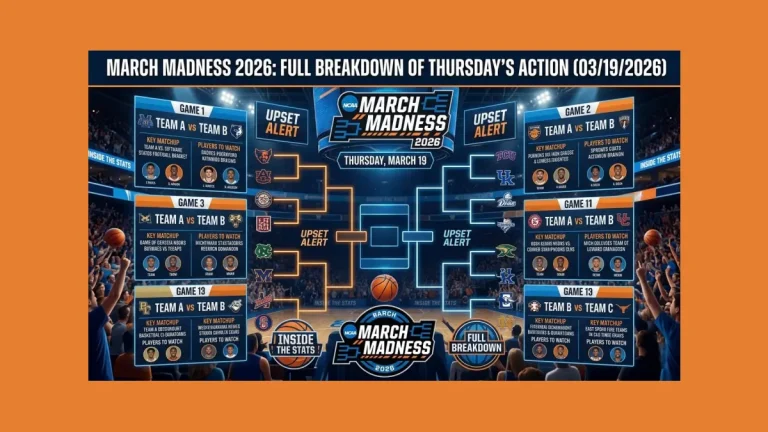
Thursday’s slate of March Madness games delivered everything fans crave in March — drama, chaos, and the kind of momentum swings that can define an entire tournament. While some teams solidified their status as true contenders, others raised serious questions about how far they can really go.
From breakout stars to coaches under pressure, here are the five biggest winners and losers from Thursday’s action.
Winner: Backcourts Built for March
Guard play has always been the engine of deep tournament runs, and Thursday was a masterclass in why that still holds true. Several teams rode their backcourts to victory, leaning on ball security, shot creation, and late‑game composure.
One top‑seeded team survived a serious scare thanks to its veteran point guard, who took over in the final four minutes — scoring, facilitating, and calmly breaking the press. Another mid‑major pulled off an upset behind a fearless combo guard who attacked the rim and hit big shots from deep.
In a tournament where possessions shrink and nerves rise, the teams with guards who can create their own looks and control tempo are already separating themselves.
Winner: Underrated Mid‑Majors
Every year, there are a few mid‑majors that fans and analysts circle as “dangerous,” and Thursday proved that label right again. Several lower‑seeded programs showed they weren’t just happy to be in the tournament — they came to win.
These teams played with pace, confidence, and a clear identity. They spaced the floor, moved the ball, and punished lazy closeouts with threes. Defensively, they mixed coverages, threw in timely traps, and forced higher‑seeded opponents into uncomfortable shots late in the clock.
They may not have the five‑star recruits, but they have continuity, chemistry, and belief — and that’s a dangerous combination in March.
Winner: Coaches Who Trust Their Bench
Depth is often talked about but not always used. On Thursday, the coaches who trusted their bench players were rewarded. With quick turnarounds and high‑intensity minutes, fresh legs made a huge difference.
One coach turned to a little‑used reserve early in the second half, and the move changed the game. The bench player brought energy on defense, attacked the glass, and knocked down open shots. Another team’s second unit held a lead while the starters rested, preventing a run that could have flipped the outcome.
In a tournament where teams may play twice in three days, those extra minutes from the bench can be the difference between advancing and going home.
Loser: Inconsistent Three‑Point Shooting
Several higher‑seeded teams lived — and nearly died — by the three‑point line. Cold stretches from deep turned comfortable leads into tight finishes, and in a few cases, opened the door for upsets.
One favorite went ice‑cold from beyond the arc in the final eight minutes, settling for contested jumpers instead of attacking the paint. Another team launched threes early in the shot clock, abandoning the ball movement that had built their lead.
When the shots fall, the offense looks unstoppable. When they don’t, it exposes a lack of balance and a reluctance to adjust. Thursday was a reminder that relying solely on perimeter shooting is a risky way to survive March.
Loser: Turnover‑Prone Offenses
Nothing kills momentum faster than turnovers, and a few teams learned that the hard way. Sloppy ball‑handling, forced passes, and miscommunication in the half court led directly to fast‑break points the other way.
One team coughed up the ball on three straight possessions in the final two minutes, turning a one‑point lead into a two‑possession deficit. Another squad struggled against full‑court pressure, repeatedly failing to get into their sets before the shot clock dipped under 10 seconds.
In March, every possession matters. Teams that can’t value the ball rarely last long.
Loser: Defenses That Can’t Guard the Perimeter
As spacing and shooting continue to evolve, perimeter defense is more important than ever. On Thursday, a few teams simply couldn’t keep up with quick guards and shooters coming off screens.
Late closeouts, poor communication on switches, and over‑helping in the paint led to wide‑open looks from deep. Opponents took full advantage, knocking down threes that silenced runs and energized their own benches.
If these defensive issues aren’t fixed quickly, they’ll be exposed even more in the next round.
What It All Means Moving Forward
Thursday’s action reinforced a few core truths about March Madness:
- Elite guard play still wins in March.
- Mid‑majors with identity and experience are always dangerous.
- Depth and bench trust matter over a long weekend.
- Turnovers and defensive lapses are fatal against quality opponents.
As the tournament moves into the weekend, expect the intensity to rise, the margins to shrink, and the spotlight to grow even brighter on the teams and players who can handle the moment.
Tags: March Madness, NCAA Tournament, College Basketball, 2026 Tournament, Bracket Breakdown, Winners and Losers, Sports Analysis, DUH Press, Basketball News

Welcome to 234sport.com, your go-to hub for the latest and greatest in sports news and entertainment! At 234sport, we deliver electrifying stories, comprehensive analyses, and real-time coverage of all your favorite sports. In addition to DIY, education, and current event stories. From football to basketball, along with the latest current events, we’ve got it all. Our passionate team of sports and educational aficionados work tirelessly to provide you with fresh content so you never miss a moment. Immerse yourself in our news articles with expert insights and analysis today. Stay informed, entertained, and ahead of the game with 234sport.com—where sports news & entertainment is our game!
See your link/ad on 234sport.com today!